The small business marketing funnel: from awareness to revenue
 Rupal Patel
on
Rupal Patel
on
Most small businesses spend their marketing budget at the bottom of the funnel and wonder why it is not working.
They run ads to audiences who have never heard of them. They push offers to people who have no reason to trust them yet. They optimize for immediate conversion from a cold audience that is not ready to convert.
Then they conclude that marketing does not work for their business.
Marketing works. The funnel does not work when it is missing the stages that have to come before the sale. A small business that understands how to build and activate all three stages of the marketing funnel, awareness, consideration, and conversion, consistently outgrows one that is spending the same budget on conversion tactics alone.
This guide explains how the funnel works, what each stage requires, and how a small or growing business builds a full-funnel marketing system without an enterprise budget.
Key Takeaways
- The funnel has three stages and all three have to work: Awareness brings the right people into contact with your business. Consideration builds enough trust and credibility for them to evaluate you seriously. Conversion creates the conditions for a purchase or inquiry decision. Skipping stages creates the illusion of marketing activity without the results that follow when the full system is in place.
- Most small business marketing investment is concentrated at the wrong stage: Conversion-stage tactics, paid ads, promotions, and direct offers, are the most visible and the most intuitive place to spend. They are also the least effective when the awareness and consideration stages are not built to support them.
- Content is the primary awareness and consideration tool for most small businesses: Organic search, social media, and educational content build awareness and trust at a fraction of the cost of paid conversion campaigns, and they compound over time in a way that paid campaigns do not.
- The consideration stage is where most small business marketing fails: Businesses invest in making people aware and then in converting them, with almost nothing in between to build the trust that makes conversion possible. The consideration gap is where leads are lost before they ever become inquiries.
- Your website is the conversion stage: Every dollar spent on awareness and consideration ultimately sends traffic to your website. A website that does not convert those visitors into leads or inquiries wastes the upstream investment that drove them there.
- The funnel is not linear: Real buyers move through the stages non-linearly, sometimes jumping from awareness to purchase, sometimes cycling between consideration and awareness for months before converting. Building content and touchpoints at every stage ensures you are present wherever in the journey a potential customer happens to be.
- Measurement at each stage prevents misdiagnosis: A business with low conversion rates does not necessarily have a conversion problem. It may have a consideration problem where trust is not high enough to support conversion, or an awareness problem where the wrong people are being driven to the bottom of the funnel. Measuring each stage separately tells you where the problem actually is.
- The full-funnel system compounds: Each stage strengthens the others. Better awareness content drives higher-quality consideration traffic. Better consideration content improves conversion rates. Improved conversion creates case studies and testimonials that strengthen awareness content.
What the marketing funnel actually is
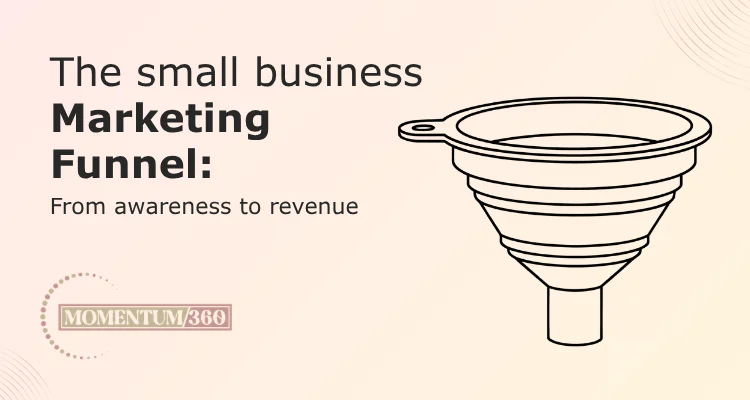
The marketing funnel is a model for the customer journey from first awareness of your business to a purchase decision. It is called a funnel because the audience gets smaller at each stage: many people become aware of your business, fewer actively consider it, and fewer still convert to customers.
Understanding the funnel matters for a simple reason: the marketing that works at each stage is different. What makes someone aware of your business is not what makes them trust it enough to buy. What makes them trust you is not the same as what prompts them to act on that trust.
The three stages and what happens in each
- Awareness: The potential customer learns your business exists. They find you through a Google search, a social media post, a referral, a piece of content, or an ad. At this stage they are not evaluating your business specifically. They are becoming aware that a solution like yours exists.
- Consideration: The potential customer is aware of you and is evaluating whether you are a credible, relevant option for their specific need. They read your website, look at your reviews, compare you to alternatives, and form an opinion about whether you can help them. Trust is the primary currency at this stage.
- Conversion: The potential customer has enough awareness and trust to take an action: making a purchase, submitting an inquiry, booking a consultation, or calling. This is the stage where most small business marketing investment is concentrated, and the stage that delivers the lowest return when the earlier stages have not been built to support it.
Stage 1: Building awareness without a brand marketing budget
Small businesses do not need a television campaign to build meaningful awareness. The most effective awareness tools are organic search, social media content, and referral systems, all accessible at a fraction of what paid awareness campaigns cost.
Organic search awareness
When a potential customer searches for information related to the problem your business solves, appearing in those search results is an awareness moment that costs nothing per impression once the content is built and ranked. The content that drives awareness-stage organic search is educational and informational: it answers questions your potential customers are already asking rather than promoting your business directly.
Social media awareness
Social media is an awareness channel when the content is genuinely useful, entertaining, or relevant to the audience rather than promotional. Consistency matters more than production quality for most small business social media. Twelve posts per month of useful content outperforms two posts per month of highly produced content for awareness building over a six-month period.
Referral systems
The most powerful and most underbuilt awareness channel for most small businesses is the referral system. Existing customers who are genuinely satisfied have direct access to networks of potential customers who would trust a peer recommendation over any advertising message. Building a referral system means making it easy and natural for satisfied customers to refer others.
Stage 2: Building consideration through trust
Consideration is the most commonly underdeveloped stage of the small business marketing funnel. Most businesses invest in awareness and then rely on the conversion stage to close the gap. The result is high lead volume with low conversion rates because the customer did not develop enough trust during the consideration stage to commit.
Trust is built through three primary mechanisms: social proof, expertise demonstration, and clarity.
- Social proof: Reviews, testimonials, case studies, and evidence that other people have trusted your business and had a good experience reduce the perceived risk of choosing you.
- Expertise demonstration: Content that demonstrates genuine expertise in your field builds the confidence a customer needs before they commit.
- Clarity: Confusion kills consideration. A potential customer who cannot clearly understand what you offer, who it is for, and what it costs is a customer who leaves before converting.
Stage 3: The conversion stage
Conversion is where potential customers take the action you have been building toward. Four elements drive conversion rate:
- A clear, frictionless next step: The customer who is ready to act should never have to search for how to take that action. One primary CTA, clearly positioned, with the fewest possible steps between intent and action.
- Trust signals at the conversion moment: Reviews, credentials, guarantees, and social proof matter most at the moment a customer is deciding whether to commit.
- Speed: A potential customer who fills out a contact form and does not hear back within one business day is a customer who is contacting your competitor in the meantime.
- Appropriate urgency: Legitimate urgency, limited availability, a relevant deadline, or a genuine time-sensitive offer, supports conversion. Manufactured urgency undermines trust and conversion simultaneously.
Measuring your funnel: diagnosing where growth is actually stalling
One of the most practical benefits of thinking in funnel stages is the ability to diagnose where a marketing problem actually exists.
| Symptom | Stage Diagnosis | Fix |
|---|---|---|
| Low website traffic | Awareness problem | More SEO, social, content, referral investment |
| High traffic, low inquiries | Consideration or conversion problem | Improve trust signals, clarity, CTA friction |
| High inquiries, low close rate | Sales process problem | Not a marketing funnel issue - review the sales conversation |
Building a full-funnel system on a small business budget
- Awareness priorities: Local SEO and Google Business Profile optimization, content marketing targeting the questions your customers are already searching, consistent social media presence, and a structured referral request process.
- Consideration priorities: A website that clearly communicates your value and builds trust through social proof, a systematic review generation process, two to three expert content pieces per month, and case studies that show what working with you produces.
- Conversion priorities: One clear primary CTA on every page, a contact or booking process with the minimum possible steps, a one-business-day response time standard, and trust signals positioned at every conversion point.
Why growing businesses choose Momentum360
Building a full-funnel marketing system is a strategic exercise, not a tactical one. Momentum360 works with small and growing businesses as an embedded strategic partner, building the awareness, consideration, and conversion infrastructure that turns marketing activity into measurable revenue growth. If your marketing feels like activity without results, the problem is almost always structural. The funnel is missing stages, measuring the wrong outcomes, or investing at the wrong stage for where your specific business is in its growth.
Conclusion
The marketing funnel is not a theory. It is a practical framework for diagnosing where customer acquisition breaks down and where investment creates the most return. Small businesses that build all three stages and measure movement between them consistently outgrow those that concentrate their investment in conversion tactics alone.
Frequently asked questions

Rupal Patel
Founder & Fractional CMO, Momentum360
Rupal shares practical insights on marketing strategy, lead generation, digital growth, healthcare marketing, and customer acquisition. Her content is shaped by years of hands-on experience helping businesses improve visibility, attract qualified leads, and achieve sustainable growth.