GLP-1 and Weight Loss Clinic Marketing: Compliant Acquisition in a Hot Vertical
 Rupal Patel
on
Rupal Patel
on
GLP-1 medications have created the fastest-growing patient acquisition opportunity in the wellness and functional medicine space in years. They have also created one of the most compliance-intensive marketing environments any clinic owner has ever tried to navigate.
The demand is real. The competition is intense. And the regulatory environment, as covered in our guide to GLP-1 telehealth marketing, has moved from warning letters to enforcement orders in a single calendar year.
This guide is specifically for in-person and hybrid weight loss and wellness clinics offering GLP-1 programs: the patient acquisition strategy, the creative approach, the SEO and content framework, and the compliance guardrails that keep your marketing defensible while the category matures.
Key Takeaways
- The GLP-1 patient is highly motivated but increasingly skeptical: After two years of aggressive telehealth marketing and FTC enforcement actions, GLP-1 patients in 2026 are researching more carefully before choosing a provider. Clinical credibility, transparent pricing, and realistic outcomes communication are now conversion drivers, not just compliance requirements.
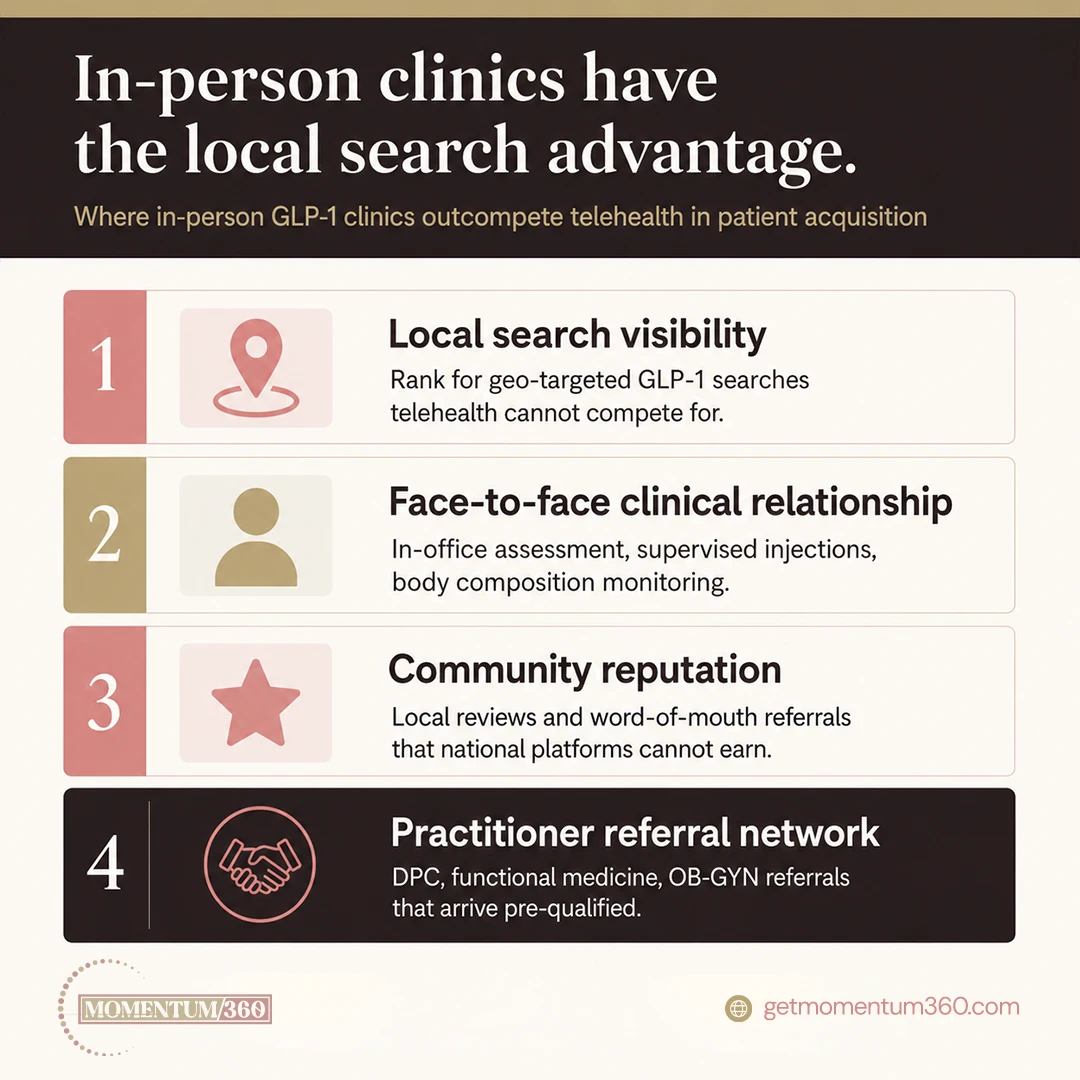
- In-person and hybrid clinics have a credibility advantage over pure telehealth: The ability to conduct in-office assessments, provide supervised injections, offer body composition monitoring, and deliver face-to-face clinical relationships differentiates brick-and-mortar weight loss clinics from telehealth-only competitors. Market this advantage explicitly.
- Local SEO is the primary acquisition channel for in-person GLP-1 clinics: Patients searching "GLP-1 clinic near me," "semaglutide doctor Atlanta," and "weight loss clinic Alpharetta" are high-intent and geographically committed. Ranking for these searches generates better-qualified patient inquiries than national telehealth advertising can produce.
- Compounding program marketing requires specific FDA compliance awareness: The FDA's September 2025 enforcement initiative and the April 2024 removal of semaglutide from the shortage list have created a shifting regulatory environment for compounded GLP-1 marketing. All claims about compounded medications must be carefully reviewed against current FDA guidance before publishing.
- Content that educates on the full program converts better than content focused on the drug: Patients searching for GLP-1 programs want to understand the clinical supervision, the monitoring protocol, the nutrition support, and the long-term sustainability plan as much as the medication itself. Content that addresses the full program architecture converts more qualified patients than drug-focused creative.
- Pricing transparency is both a compliance requirement and a conversion driver: After the FTC's NextMed enforcement action, transparent pricing is non-negotiable. It is also genuinely effective at converting the right patient. The patient who books after seeing your full program pricing is far less likely to churn after the first month than the patient who books before understanding the total cost of care.
- Referral partnerships with aligned practitioners compound patient acquisition: DPC physicians, functional medicine practices, OB-GYNs, and cardiologists whose patients are GLP-1 candidates are the highest-quality referral source for an in-person weight loss clinic. These referrals arrive medically vetted, motivation-aligned, and LTV-positive.
- Retention marketing is the margin play: The weight loss clinic that acquires a patient and then loses them after three months is running a high-cost acquisition treadmill. The clinic that builds systematic retention communication, ongoing outcome tracking, and proactive re-engagement programs converts one-time GLP-1 users into long-term wellness patients with dramatically higher LTV.
The GLP-1 clinic landscape in 2026: opportunity and compliance reality
The GLP-1 market in 2025 and 2026 has gone through a significant maturation cycle that every clinic marketing team needs to understand before building a patient acquisition strategy.
In 2023 and 2024, aggressive growth-at-any-cost marketing was common across both telehealth and in-person GLP-1 providers. Hidden pricing, unsubstantiated weight-loss claims, incentivized reviews, and compounded medication marketing that implied equivalence with branded drugs were all standard practices in the category.
The regulatory response was swift and coordinated. The FTC finalized a consent order against NextMed in December 2025 for exactly these violations. The FDA and HHS issued more than 40 warning letters and more than 100 cease-and-desist letters to compounding pharmacies and telehealth providers through a presidentially directed enforcement initiative in September 2025. The FTC's earlier enforcement actions against GoodRx and Cerebral established the data privacy and sensitive health information framework that applies to all digital health marketing.
The result is a market where the compliant clinics are now differentiating themselves from the non-compliant ones simply by doing marketing correctly. Transparent pricing, substantiated outcomes claims, authentic patient testimonials, and clear compounding disclosure are not just compliance requirements. They are the positioning of a clinic that intends to be in this market in five years.
For in-person and hybrid weight loss clinics in 2026, this environment is an opportunity. The telehealth-only competitors that were growing through compliance shortcuts are now either under enforcement scrutiny or rebuilding their marketing infrastructure. The local clinic with a credible, transparent, clinically supervised program is filling a trust gap that the category's compliance failures created.
Bottom Line: The GLP-1 market's compliance maturation is creating a competitive advantage for in-person and hybrid clinics that market correctly. Build that foundation and the differentiation sells itself.
Local SEO for GLP-1 and weight loss clinics
In-person GLP-1 clinic patients are local searchers. They are not comparing national telehealth options. They are searching for a supervised weight loss program, a GLP-1 prescriber, or a semaglutide clinic within driving distance of where they live or work.
This makes local SEO the primary patient acquisition channel for most brick-and-mortar weight loss clinics, and one of the clearest competitive advantages over telehealth-only competitors who are not optimized for local search at all.
What GLP-1 clinic local SEO requires
A Google Business Profile optimized for weight loss, medical weight loss, and GLP-1 or semaglutide services where those category terms are available. Your GBP is the first result a local patient sees when searching for weight loss services near them. It needs complete, accurate information, consistent review generation, and regular posts communicating your program and clinical approach.
Condition and service-specific landing pages targeting the searches your Atlanta-area patients are actually making. "GLP-1 clinic Atlanta," "semaglutide doctor near me," "medical weight loss Alpharetta," "weight loss clinic Buckhead," and "tirzepatide program Georgia" are the patient-intent search terms your content needs to capture.
Neighborhood and suburb targeting that reflects the Atlanta market. Patients in Alpharetta, Sandy Springs, Buckhead, Midtown, and the northern suburbs are high-income, health-conscious, and active searchers for GLP-1 and weight management programs. Geo-targeted content for these specific communities outperforms generic Atlanta-wide content for local search visibility.
Clinical credibility signals throughout. Provider credentials, clinical supervision descriptions, monitoring protocol details, and before-and-after content with proper consent and outcomes disclosure are both SEO assets and conversion drivers. They signal E-E-A-T to Google and clinical confidence to the patient simultaneously.
AEO optimization on every key page. Open each section with a direct two-sentence answer to the patient's most likely question. This earns citations in Google AI Overviews, ChatGPT, and Perplexity where an increasing share of GLP-1 patient research is beginning.
Compliant GLP-1 creative: what works and what creates enforcement exposure
The creative approach for GLP-1 clinic marketing in 2026 is not about making the marketing safer by making it blander. It is about earning patient confidence through clinical transparency, substantiated outcomes communication, and a program narrative that goes beyond the medication itself.
The patient who is most valuable to a weight loss clinic is not the one who calls after seeing a "$99/month" ad. It is the one who calls after reading your clinical program overview, understanding the supervision and monitoring protocol, reviewing your provider credentials, and deciding that your specific approach to medically supervised weight management is worth the investment.
Compliant, transparent marketing self-selects for that patient.
What compliant GLP-1 clinic creative includes
Program-focused messaging that leads with clinical supervision, monitoring, and support rather than drug-first creative. "A medically supervised weight management program with ongoing clinical support and outcome tracking" is a stronger and more compliant message than "lose weight with semaglutide."
Transparent, complete pricing that includes all program components. Medication costs, consultation fees, monitoring visits, and any required lab work must be clearly disclosed before a patient makes any financial commitment. The FTC's NextMed enforcement established this as a hard requirement, not a best practice.
Substantiated outcomes language. Real patient results disclosed as individual outcomes, not typical results. "Our patients have experienced significant weight loss" is defensible. "Lose 23% of your body weight" without data supporting that as a typical outcome is an enforcement target.
Authentic patient testimonials with proper consent and disclosure. Video testimonials from real patients who experienced your specific program, with disclosed relationships and accurate outcomes, build the trust that converts skeptical researchers into booked consultations.
Compounding disclosure where applicable. If your clinic offers compounded semaglutide or tirzepatide, your marketing must not imply equivalence with FDA-approved branded medications, claim clinical proof for compounded formulations, or imply FDA approval. The FDA's September 2025 warning letters were specific about these four claim categories.
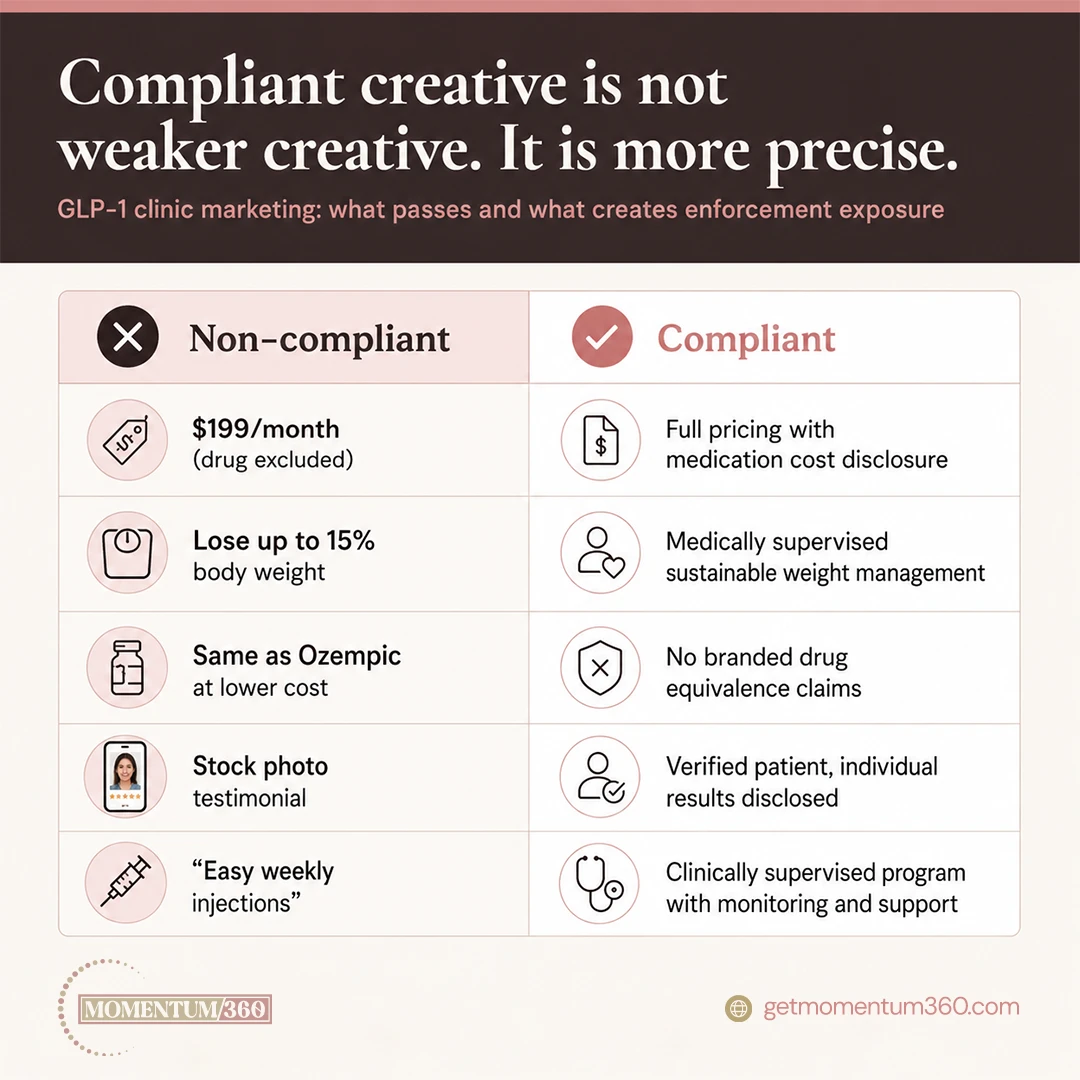
Compliant vs. non-compliant GLP-1 clinic creative comparison
| Creative Element | Non-compliant | Compliant |
|---|---|---|
| Program Pricing | "$199/month" (medication excluded) | "$199/month consultation fee. Medication costs vary by formulation. Full pricing provided at consultation." |
| Outcomes Claim | "Lose up to 15% of your body weight" | "Our patients work toward medically supervised, sustainable weight management goals" |
| Drug References | "Same medication as Ozempic at a fraction of the cost" | No branded drug equivalence claims |
| Testimonials | Stock photo with fabricated quote | Verified patient testimonial with individual results disclosed |
| Program Description | "Easy weekly injections" | "Clinically supervised program including provider consultation, lab monitoring, and ongoing support" |
Bottom Line: Compliant GLP-1 clinic marketing is more precise, not weaker. It attracts the patient who is ready to invest in a clinical program and repels the patient who was looking for a shortcut. That is a better patient acquisition filter, not a worse one.
Content strategy for GLP-1 and weight loss clinics
The GLP-1 patient research journey is thorough. Before booking a consultation, most patients have read multiple articles, watched provider videos, compared programs, and evaluated several clinics against each other.
A content library built around the full program experience, not just the medication, positions your clinic at every stage of that research journey.
Program architecture content. Detailed explainers on how your GLP-1 program works: the initial consultation and lab assessment, the medication titration protocol, the monitoring schedule, the nutrition and lifestyle support component, and the long-term maintenance plan. This content educates the serious patient and filters out the casual enquirer simultaneously.
Condition and candidate content. "Are you a good candidate for GLP-1 therapy," "what to expect in the first 90 days of a medically supervised weight loss program," and "how GLP-1 medications work in the context of metabolic health" are the educational pieces that move a curious patient toward booking a consultation.
Outcomes and expectations content. Realistic, substantiated outcomes communication that sets appropriate expectations for a medically supervised weight loss program. Patients who understand what they are committing to before they start are more likely to complete the program and refer others.
FAQ content structured for AI answer engines. "What is the difference between semaglutide and tirzepatide," "how long does it take to see results from a GLP-1 program," "is GLP-1 therapy right for someone without diabetes," and "what happens when you stop taking GLP-1 medication" are the questions patients are asking ChatGPT and Perplexity. Owning these answers with practitioner-attributed, structured content earns AI citation visibility.
Referral partnerships for GLP-1 clinics
The highest-quality GLP-1 patient is often referred by a practitioner who has already assessed their candidacy. DPC physicians, functional medicine practices, cardiologists managing metabolic risk, OB-GYNs treating PCOS or perimenopausal weight gain, and endocrinologists whose patients are not candidates for branded GLP-1 medications due to cost are all productive referral sources for in-person GLP-1 clinics.
Building these referral relationships requires the same discipline as any B2B outreach: clear communication about which patients you serve best, a consistent outreach cadence, and materials that make it easy for a referring practitioner to explain your program to a patient they are sending your way.
Retention: the margin play that most GLP-1 clinics are leaving on the table
Patient acquisition for a GLP-1 program is expensive. Retaining that patient through the full program and converting them to an ongoing wellness relationship is where the economics of running a weight loss clinic actually work.
The clinics with the best retention are not those with the best medication protocols. They are the ones with the most proactive communication programs: regular outcome check-ins, proactive outreach when patients miss an appointment or a refill, educational content that reinforces the lifestyle components of the program, and a clear transition plan from active medication phase to long-term maintenance.
Build the retention program before you scale acquisition. The math of patient LTV in a GLP-1 program is too favorable to leave to chance.
Why GLP-1 and weight loss clinics choose Momentum360
GLP-1 clinic marketing in 2026 requires a partner who understands both the regulatory environment and the patient acquisition strategy well enough to build a program that is compliant, credible, and genuinely effective at attracting the right patients.
We have built marketing programs across the GLP-1, functional medicine, and wellness verticals with a consistent approach: compliance infrastructure first, then content authority, then paid amplification. For in-person and hybrid weight loss clinics, that means a local SEO foundation that captures the high-intent local searcher, content that builds clinical credibility across the full program journey, and a paid media setup that does not create the compliance exposure that has ended other practices in this category.
Conclusion
The GLP-1 market is maturing. The shortcuts that worked in 2023 are now enforcement targets. And in-person and hybrid weight loss clinics that market correctly are filling the trust gap that the category's compliance failures created.
Transparent pricing, substantiated outcomes, authentic patient stories, clinical program content, local SEO built around genuine community presence, and a referral network that generates pre-qualified patients are the compounding assets that build a durable GLP-1 clinic patient base.
The patients looking for a medically supervised, clinically credible weight management program in Atlanta and across Georgia are searching right now. Your marketing just needs to be in the right place, saying the right things, to the right level of clinical depth, to earn their consultation.
Frequently Asked Questions
Note: This blog is marketing guidance, not legal advice. GLP-1 and weight loss clinics should consult legal and compliance counsel for FDA, FTC, HIPAA, and platform-specific advertising decisions.

Rupal Patel
Founder & Fractional CMO, Momentum360
Rupal shares practical insights on marketing strategy, lead generation, digital growth, healthcare marketing, and customer acquisition. Her content is shaped by years of hands-on experience helping businesses improve visibility, attract qualified leads, and achieve sustainable growth.