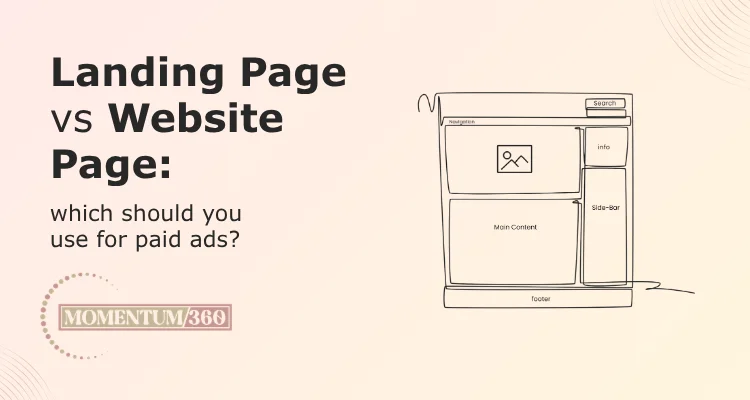
Landing page vs website page: which should you use for paid ads?
 Rupal Patel
on
One of the most consistent and most costly paid advertising mistakes growing businesses make is sending paid traffic to their website homepage.
The homepage is not built to convert paid traffic. It is built to serve every type of visitor who arrives through every channel simultaneously. It has multiple navigation options, multiple CTAs, and multiple audiences in mind. That breadth is appropriate for a homepage. It is the opposite of what a paid ad campaign needs.
Paid ad traffic needs a landing page: a single-purpose page built to convert the specific visitor who clicked a specific ad for a specific offer, with no distractions, no navigation options to wander through, and no competing CTAs.
Key Takeaways
- Sending paid ad traffic to a website homepage consistently underperforms: The homepage serves too many audiences with too many options. A landing page serves one audience with one offer and one next step.
- A landing page is a single-purpose page with no navigation, one offer, and one CTA: Every element on the page is designed to do one thing: move the specific visitor toward a single conversion action.
- A website page is a multi-purpose page built to serve organic, referral, and direct visitors: It has navigation, multiple CTAs, links to other pages, and content designed to serve visitors at different stages of the buying journey.
- The relevance match between ad and landing page is the primary driver of conversion rate and quality score: A visitor who clicks an ad about Google Ads management and lands on a page specifically about Google Ads management converts at significantly higher rates than one who lands on a generic services page.
- Landing pages should not have website navigation: Navigation gives visitors an exit route to other parts of the website, reducing the probability that they take the specific action the page is built for.
- One offer per landing page: A landing page that promotes two or three services simultaneously is not a landing page. It is a website page without navigation.
- Landing pages need the same trust signals as website pages, positioned more strategically: Reviews, credentials, guarantees, and social proof still matter, positioned specifically to support the single conversion action.
- Testing is how landing pages improve: The difference between a 2 percent and a 5 percent converting landing page is often a single headline change, a different CTA, or a trust signal repositioned above the fold.
The fundamental difference: purpose
The difference between a landing page and a website page is not visual. It is purposeful.
A website page is designed to serve multiple purposes simultaneously. The homepage needs to introduce the brand to a first-time visitor, confirm to a returning visitor that they are in the right place, communicate the range of services offered, and direct different types of visitors toward different parts of the site.
A landing page is designed to serve one purpose: converting a specific visitor who arrived through a specific channel because of a specific offer or message. The single-purpose constraint is the landing page's strength.
When to use a landing page for paid ads
A dedicated landing page is the right choice for any paid advertising campaign where the conversion goal is specific: a consultation booking, a quote request, a free trial sign-up, or any other defined action that can be optimized for.
The rules that determine when a landing page is required:
- When the ad makes a specific offer that is not immediately visible on any existing website page.
- When the ad targets a specific audience segment with messaging tailored to that segment.
- When conversion rate and cost per acquisition matter, which is always for paid campaigns.
- When the Google Ads quality score matters, which affects the CPC you pay.
When a website page is appropriate for paid ads
There are specific scenarios where sending paid traffic to an existing website page is acceptable or even preferable:
- Brand awareness campaigns where the conversion goal is a website visit rather than a specific action.
- Branded search campaigns where someone has searched specifically for the business name and is already familiar with the brand.
- Remarketing campaigns targeting visitors who have already been through the awareness and consideration stages.
What a high-converting landing page includes
The headline: message match above all else
The first job of the landing page headline is message match: it must immediately confirm to the visitor that they landed in the right place by echoing the language of the ad they clicked. Message match reduces bounce rate because the visitor who sees their specific intent reflected in the headline immediately confirms they are in the right place.
The subheadline: why this offer, why now, why you
The subheadline gives the visitor the next level of specificity: what exactly the offer includes, what makes the provider credible to deliver it, and what the visitor will get from taking the action.
Social proof: the trust signal that converts
The most converting landing page social proof is a short, specific testimonial that names the outcome the customer achieved. Place it above the fold, near the CTA, where the visitor is making their trust evaluation.
The offer: clear, specific, and low-friction
"A 30-minute video call where we review your current marketing and give you three specific actions to take in the next 30 days, regardless of whether you work with us" is more converting than "Book a free consultation."
The form: minimum required fields
Name, email, and one qualifying question. That is typically the right balance between friction reduction and lead qualification for a service business first-contact form on a paid landing page.
No navigation
Remove the website navigation header and footer from landing pages. Every link on the page is an exit opportunity that reduces the probability the visitor takes the specific conversion action the page is built for.
The impact of landing pages on Google Ads quality score
| Standard approach: homepage for all paid traffic | Better approach: dedicated landing page per campaign |
|---|---|
| Generic headline serving all audiences | Headline exactly matches the ad's promise |
| Multiple navigation links and CTAs | No navigation, single CTA |
| Broad content for all visitor types | Content specific to the audience segment |
| Lower relevance score for the keyword | Higher relevance score, lower CPC |
| Typical conversion: 1 to 2 percent | Typical conversion: 3 to 5 percent or more |
Testing: how landing pages improve from good to great
The difference between a 2 percent and a 5 percent converting landing page is almost never obvious from looking at the page. It is found through systematic testing of specific elements.
The elements worth testing first on a landing page are the headline, the CTA text, the offer description, and the social proof selection and positioning. Test one element at a time.
Even modest conversion rate improvements produce significant improvements in paid advertising ROI. A single winning headline test that moves conversion from 2 percent to 3 percent at $5 CPC reduces the cost per lead from $250 to $167. Over a $5,000 monthly ad spend, that is the difference between 20 leads and 30 leads for the same budget.
Why growing businesses choose Momentum360 for paid media
Landing page strategy is paid media strategy. Momentum360 builds paid media programs for growing businesses that include the landing page strategy and execution that makes ad spend efficient, not just the campaign management that drives the click.
Conclusion
The choice between a landing page and a website page for paid ads is not a design decision. It is a conversion decision. A dedicated landing page with no navigation, one offer, one CTA, and message-matched content consistently outperforms a website page for paid ad conversion.
Send paid traffic to pages built for paid traffic. The conversion rate improvement justifies every hour of investment in building them correctly.
Frequently asked questions

Rupal Patel
Founder & Fractional CMO, Momentum360
Rupal shares practical insights on marketing strategy, lead generation, digital growth, healthcare marketing, and customer acquisition. Her content is shaped by years of hands-on experience helping businesses improve visibility, attract qualified leads, and achieve sustainable growth.